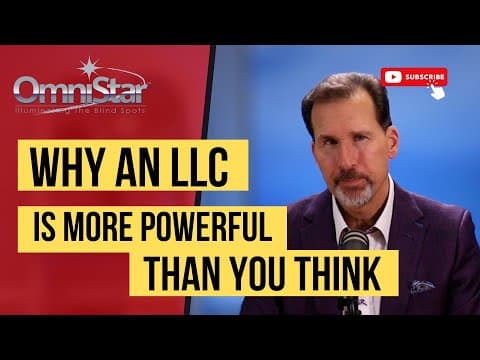
This Simple Tax Move Could Save You Thousands - Here's How!
In this video, we'll show you an unbelievable tax trick that can save you tons of money on your taxes!
Published March 1, 2023
Transcript
Welcome back to We're Talking Money. I'm Dustin Hocken, wealth advisor at OmniStar Financial Group. Today I'm going to share with you a financial planning strategy that could save you hundreds of thousands of dollars per year. Stay tuned. I will run through a few real life examples later in the show, but first let me explain what we need to do and why it works.
This strategy involves placing a piece of property inside of an LLC so that property can act as a business. You'll need to separate yourself from this said property, and this is very important, because eventually what we want is for this business to help us save money on taxes, and trust me, the savings could be massive.
Before I go any further, please like, share, subscribe, all that good stuff. It really does make a big difference for our channel and we really appreciate the support.
Alright, so back to our strategy. Once you have the property inside of an LLC, you must set this up as a business that has created for profit. This is very important. This also won't work if it looks like your business's only goal is to lose money every year.
The IRS code section 183 says activities not engaged for profits limits the number of deductions that can be claimed. This is commonly referred to as the hobby loss rule. With this situation, we'll need to consider the following: is your hobby really an activity in engaged in for profit? Does the time and effort put into an activity indicate an intention to make a profit? Do you depend on the income from the activity? These are just a few of the questions that the IRS will ask. I've included a link to the full IRS fact sheet in the description below.
An activity is presumed for profit if it makes a profit and at least three of the last five years. If an activity is not for profit, losses from that activity may not be used to offset other income.
So how would this work in the real world, and how could this potentially benefit you? I have two examples for us to walk through together.
The first example would be if you own an expensive yacht. It would likely make sense to place this yacht and LLC strictly from a liability standpoint, but we can even get a little more strategic than that. We can place the yacht in the LLC and then we can lease the yacht from the LLC when we want to take it out on the water. If we need crew members, we can take our lease payment to pay those crew members. This allows the LLC to deduct the wages of the crew members, compared to you paying for those wages with after tax dollars. This also allows us to deduct expenses and depreciation for the yacht.
The next example would be if you owned a lot of land. In order to take care of this land, you're likely going to need to buy very large and very expensive equipment. What you should do is place the land in an LLC and have the LLC buy the equipment. This will allow you to deduct the cost of the equipment from your taxes. If you have timber on the land, you can remove the trees, also known as trimming, to sell them for a profit, and then replant the trees. This could easily satisfy the requirement for the IRS. If you could plant some apple trees on your land, this would be considered a for-profit business as well.
Like always, you want to confirm with your CPA to be sure that this strategy is feasible for you. Once we get to this level of planning there's a lot of moving pieces, but the reward is well worth it. It's so important that you build a good team so you can make these strategies as easy as possible.
I hope that's helpful. Please like, share, subscribe to our YouTube page. Certainly appreciate the support. We'll talk to you soon.
Thanks for joining us on We're Talking Money. Be sure to visit us at omnistarfinancial.com, where you can learn more about how we provide value to our clients. So subscribe to the show and our newsletters, and drop us a line with topic suggestions for upcoming shows. If you enjoyed the show, we would appreciate you passing it on to a friend and providing a rating on iTunes.
This podcast is a publication of OmniStar Financial Group. The content is developed from sources believed to be reliable and accurate with all information. The information in this material is not intended as tax or legal advice, may not be used for the purpose of avoiding any federal tax penalties. Please consult legal or tax professionals for specific information regarding your individual situation. The opinions expressed and material provided are for general information and should not be considered a solicitation for the purchase or sale of any security or service provided by OmniStar. All expressions of opinion reflect that of the authors and are subject to change. Any distribution, use or copying of this podcast other than the intended recipients is prohibited.
This transcript was generated automatically and may contain errors in names, figures and terminology. The episode itself is the authoritative version.