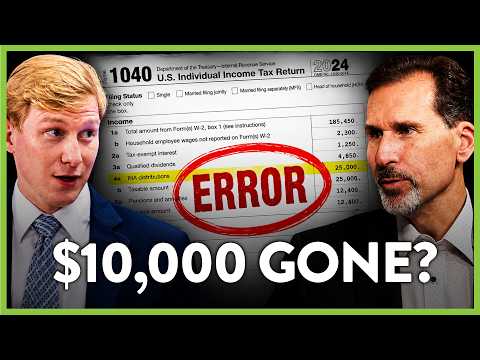
Don't Let Your CPA Do This To Your Roth IRA
Watch a professional tax return review to understand how specific financial documents impact your final tax outcome. See the process.
Published August 19, 2026
Transcript
What did it cost the client? $10 was the result.
Phil, a few weeks ago you were scanning a client's tax return, couple in their 40s, and you immediately got up from your desk, walked down the hall, and asked him a question. What did you ask him?
I know the case you're talking about. I was reviewing their tax return. Mhm. He was the lead advisor on this case, and my question was, "Why am I seeing an IRA distribution, which obviously is a fully taxable distribution?" And I was confused because these people are distributing, these people are saving. Mhm. And there could be a distribution if we're doing a Roth conversion. So, I went and asked.
And what did he say?
I think his answer was, "They did have a distribution." Okay.
What did the return say?
I think I said, "Your tax return says they did. So, somebody's wrong." Okay. "Either they did or they didn't, but I need to know because this tax return says that they did."
And by then I had the tax return loaded, looking at it, had really reviewed most of it, but that first page just jumped, it was bold. Just right in my face, and I thought, "Wait a minute." I knew the couple, know who they are, know what their goals in life are, and what they're trying to accomplish, and I knew there should be a distribution there. And so that led to a conversation with the lead advisor, and which we determined it wasn't supposed to be there.
Got it. Got it. So, how long had that been sitting on the return before someone noticed?
Well, long enough that it was filed. Long enough that the 1099s were issued. Someone got the information, filed the tax return, and taxes were paid. Mhm.
So, when you say that the error was there long enough for it to be filed, what damages did that cause? What did it cost the client?
That 8 to 10,000 dollars was the result.
What planning were we doing? What were we trying to help our clients implement that would have caused this in the first place?
Well, in this case, now that we're talking about it, I'm remembering some of the elements of this case, and what happened here is every year the lead advisor does a backdoor Roth for these people. And because their income is such that they can't do a Roth traditional style funding of a Roth, they have to do the backdoor, okay?
So, they put dollars in after tax to their traditional IRA, Mhm. and then the lead advisor, he immediately has our cashiering folks move that over to a Roth account. So, now I have that traditional IRA, it's a zero balance account, sits there, money rolls in and immediately rolls out.
Got it. Did our team do that correctly?
Yeah, our team did it correctly, and here's what happened. I don't remember the numbers necessarily, but I remember that the money did not immediately move to the Roth. It's 20 grand. It's what moved. Okay.
So what happened is it sat there long enough Yep. that some interest accrued. Mhm. And I think it was around 200 dollars maybe or 100 108 bucks.
153 dollars.
153. That 153 is what should have been on that tax return. Right. Instead, the entire backdoor amount, it was seen by the CPA firm as a distribution from a traditional IRA. Ah. When in fact, it should have been $153. $53. That was the amount that should have been on that tax return. Mhm. Not the full distribution.
So, just slow down for a second if you don't mind. How does a strategy that we're going to implement with a client that should be or cost about $153 in tax turn into an 8 or $10,000 tax event?
Well, when you end up with two people who were maximizing their what eventually becomes a Roth IRA and they're trying to put eight thousand or so dollars in a year times two people and they're paying very high income tax because they're making a lot of money. Fortunately for them, their income in their 40s, they're doing very well. Right. So, they're paying some pretty significant tax. Mhm.
So, it's all after-tax. Right. So, that money should not be taxed when it moves to the Roth in the backdoor environment. Got it. In this case, it didn't look like that to the CPA. When they saw the 1099, they thought, "Oh, this is just a full distribution."
Okay. So, stay right there. What did the CPA have on his desk? What did the CPA see?
Well, I think the CPA, the only thing they would have would be the 1099.
Which shows what?
Well, that The would show what's particularly how it's coded, right? So, depending on the code on that 1099, it would tell them is this a distribution and what type of distribution this is. I think that's where the problem began and probably started and ended right there. First, nobody asked. Yeah. Nobody bothered.
And this is what we talk about so often and I can't stress this to our listeners enough. If your CPA and your advisor, wealth advisor, financial planner, whoever it is, Spell, if they're not talking multiple times a year and actually planning for you, then you're going to miss these things because a 1099, it doesn't have a set of instructions on it. It has codes.
And for someone who is more lay or who is learning this stuff, they might not ask the right question. And if their supervisor, in this case the CPA that owns this group or owns this CPA firm, if he didn't know this is happening, then it's going to slip right past him. He's not looking at that 1099. And so this person misses it. They don't know what to ask. 1099 is exactly what it was supposed to be, but they see a distribution. And they accept it as this is a full distribution, not just the interest.
This is more and more interesting to me because clients are in their 40s, a distribution from a qualified environment, there's a penalty for that, isn't there?
Well, they got that on top of their ordinary income tax. So, they had a 10% pre-59 and 1/2 years old penalty. And that is inexcusable, right? That's going to happen, doesn't matter who you are or what you're doing. There are only a few parts of the code that allow you to avoid a 10% distribution tax, right? So, that excise tax, that's a penalty. Yep.
And everyone's going to pay that if you pull from an IRA or a qualified account pre-59 and a half unless a few special circumstances are in existence. Yeah. And if they're not, you're going to pay ordinary income tax and a 10% penalty. So, in their case, think about someone paying 30 to 35% tax and now let's pop another 10 on top of that. We're starting to head up towards 50%. Right.
And so, you asked me, "Well, how can they end up paying all this tax?" Well, this $120,000 penalty can quickly get you up to that $8,000 range. Yeah. It didn't have to be that way.
So, Phil, let's play this out for a viewer or listener. They're sitting at home. They're thinking, "I have a CPA that I like and that I trust. I have a wealth advisor that I like and that I trust. How do I know that this isn't happening to me?"
Well, first, it's a legitimate question. I think what our listeners need to take away from this, everybody listening to this, here's what you can take away. You can rest assured that unless you have intentionally asked those people to communicate with one another or unless you happen to get lucky enough to work with those professionals who insist on that level of communication, right? It's not happening. Yeah.
Phil, so someone's watching this right now. If you had to give them one question to ask their CPA after they watch this next week, what question would you tell them to ask their CPA?
Narrowing it to one question is hard. Mhm. But I think if I'm interviewing a CPA or if I already have a CPA, I think logically, are you willing to meet with my other team? Yeah. And if you are, what would that look like? How often would that need to occur? When would you think it should occur? And is there an extra cost for me for you to do that?
There shouldn't be. That should be built in to the framework. Most of these CPAs charge subscriptions these days. Or is it It should be built into that, okay? What you ought to be asking are you amenable to that or are you dealing with a CPA who wants to hold everything close to the vest and believes that they are the end-all be-all. I believe that when you get multiple sets of eyes, assuming everyone's trained well, Mhm. you're going to get a better outcome.
All right? So I asked that question to my CPA or my advisor, you could ask that to your wealth advisor. What does a good response from that person sound like?
Well, I think that the easy answer here is that they would welcome working with another advisor. That they're not a prideful person. They're a person that says, "I want you And if their answer is this, I want you to get the best outcome. Yeah. So whoever's on your team, I'm willing to work with them. I'm willing to talk with them. I'm willing to coordinate with them. And by the way, I'm even willing to tell you if I think they're doing a poor job.
That's the level of candor and honesty that you need from every professional on your team. If they're not willing to give that, you've got the wrong person.
Yeah, I with that. What does it sound like if that person is trying to dodge?
It's probably a termination letter. It's you need to get rid of them. If they're dodging that, that means that they don't play well in the same sandbox with your other professionals. Not good. Yeah. Or it means that they want to control everything. Not good. Because not any one person has all the right answers. Yep.
And I think every professional ought to appreciate that and realize that a lot of professionals out there have a lot of really good ideas. Mhm. You think you've got all of them? Is it still when I went through flight school many many many years ago, I remember my instructor saying to me, "If you ever feel like you don't need the checklist, get out of the cockpit because you're going to die." Yeah.
And I think it's the same in the professional realm of wealth management, tax work, legal work. If you believe you've got all the best ideas, you know the book by heart, so to speak, Yeah. or by rote, Yeah. you probably need to move along. It's time for you to get out of that business cuz you're going to screw up and probably screw over a lot of people. Mhm.
Last thing, Phil, which two of the 10 Elements were coordinated or maybe not coordinated in our conversation today?
And you're throwing me on the you got me on the curveball train here.
Well, that's what this whole series is about. Yeah. Is our 10 element is The 10 Elements.
Yeah, that's why our 10 Elements being coordinated so important. Mhm. Actions in one we always say affects another. Right. I'd say in this one, I guess off the cuff, we'd have to be talking about tax planning, retirement planning. Yeah. And maybe you could throw investment planning in there, but really tax planning, retirement planning. Right? Those would be our two. You could say.
Is that enough for them to offset some fees that they're paying to some of these professionals and frankly, Spell, I think that's what we're supposed to do. I smile when we're able to save our clients money like that. Yeah. Because it means we're actually doing the work that we promised to do. Yeah. And I think that affords them hopefully a better outcome. Yeah.
Well, I'm glad that you were looking at a tax return. A $20,000 transaction cost the client $8,000 and it should have cost them $153. Yeah.
This transcript was generated automatically and may contain errors in names, figures and terminology. The episode itself is the authoritative version.