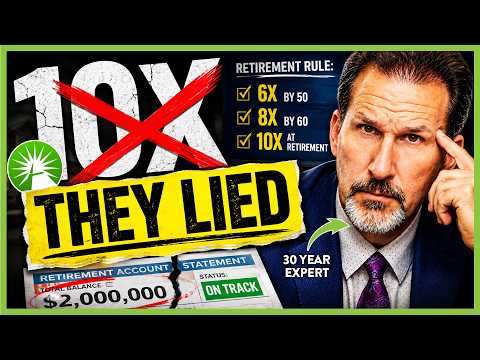
Pulling 10% a Year From Your Retirement? Here's What Happens Next
Avoid draining your retirement portfolio by fixing unsustainable withdrawal rates. Learn how one client secured their future.
Published October 7, 2026
Transcript
Right? You can be honest all day, but honesty has nothing to do with what you're willing to change. What she said was, "Maybe we need to think about how much risk we're taking. Should we be taking more?" And we're thinking that's probably not smart, right? When you're 67, 68 years old, you don't want to try to add risk. Once that happens, by the way, it's very difficult, if not impossible, to recover.
Phil, one of your clients was taking 10% a year out of their retirement portfolio and the fix had nothing to do with her investment. Tell me what happened.
Real story, real client, been with us for many, many years. I think that the unfortunate part to this kind of story, Spell, is in this case that this person, number one, has the ability to make a lot of money. They happen to be in a profession, even though they are post-retirement age, they are in a profession where they could easily dial up or down their schedule. They still work a little bit. This person still works, but they could work more if they wanted to and has the ability to make a lot of money.
Yeah.
This client just chooses not to do that.
Okay.
She really wanted to do something different in life and working a little bit.
Sure.
But literally for the last year or so, we've been noticing that our distribution rate, and this is one of those stories or one of those client relationships where you feel very comfortable talking with the client. The client understands that we're direct and we're going to tell them what to do and how to do it. And that part of the relationship's great, but this is one of those where Dave Ramsey comes into play because he says, "Hey, you can take 12%."
Yeah.
Or you could at least take 8 to 10 easily, he says, because you should be getting 12% return easily by investing in those four mutual funds that he loves. Well, the fact of the matter is over the last several years that could be done, right? That's not easy ongoing, right? And in this case 10%, when maybe you are getting 12, but you're not allowing that portfolio to grow enough to offset the rapid pace of inflation, and so that was being seen quite a bit. So yes, she was taking 10% and we had a conversation about it.
Okay. Why is 10% a problem? What happens in year five?
Well, the last couple of years it hadn't been a problem because performance has been so good. Our performance has been well beyond what Dave Ramsey talks about. For a lot of our clients, they've enjoyed much greater than a 12% return. But that's not the norm.
Right. Right.
The norm is not 12 or 15% for an allocated portfolio that's being managed for the long term, but also for someone who is at retirement. Everybody doesn't have time, right, to allow a portfolio to rebuild if we go through a major decline.
Sure.
So 10% becomes a problem if you're only averaging eight or nine or even seven.
Mhm. You're pulling more than you're growing.
And so if you're taking out more than that portfolio can grow every year, and depending on the tax nature of that portfolio, if it's an IRA, you got to take even more to give yourself net spendable.
Yep. So you could be drawing down the principal in a bull market.
It's true.
Because you're taking out more than it's earning.
Yeah. Yeah.
Well, this client said that they would cut back. Did you believe them?
We always believe our clients when they tell us something. We believe them. We believe our clients are honest.
Yep.
And you know what, Spell, I think they are. They are. We have some wonderful clients. You know that. We work with some wonderful people. They're great. They're honest. But honesty has nothing to do with what you're willing to change, right? You can be honest all day.
Yeah.
And you might believe that you're going to change or reduce your spending. This client did. I believe that she believed she would reduce spending. The fact of the matter is that didn't happen and it's probably not going to happen. We've seen this for years and we've seen it with a lot of clients where they talk themselves into the idea of reducing their spending, right? Doing it is quite different than saying it.
Yeah. Right. Yeah. Action is always a little bit harder than just talking about it.
Yeah. Yeah.
So, why wasn't she taking Social Security?
This client in particular, I can remember situations or times when we've been in a meeting and literally they will change the subject because I'm talking about things...
Yeah.
...that are a little bit biting, things that are poignant enough, they don't want to hear it because it means, or it might be a reminder, hey, remember, we've got to reduce that spending a little bit. You're still doing these things like you did when you were working full-time and making 300 a year. You're not doing that anymore, but you're still spending that way. And so sometimes I believe, Spell, people can turn off the hearing to the extent that she said to me in one of our recent meetings, maybe we need to think about how to improve portfolio performance.
And interesting.
Yes. It is interesting because people don't want to feel like they're the problem, and I get that.
Mhm.
And there are years when we're not doing as well as we want to from a performance standpoint, but in this case, her risk-adjusted performance is beyond what she ever dreamed of getting. We have benefited over really the last decade from the markets and it's been really good for her, for all of our clients. So to say, well, maybe we need to work on the portfolio. In fact, what she said was, "Maybe we need to think about how much risk we're taking. Should we be taking more?" And we're thinking that's probably not smart, right? When you're 67, 68 years old, you don't want to try to add risk. You really want to try to minimize risk to the extent that you can.
She could live another 25 years.
Yeah. Yeah. And so the money has to last a long time.
Yeah, for sure. All right, Phil, let's do an exercise here. And so I want you to run an analysis on me. So let's say that I've aged a little bit. So I'm 64 years old now.
Man, you look good for 64.
Thank you. I've been working on it really hard, man. I've got 1.8 million and I'm gonna retire next year. That's my goal. So give me my number. Don't give me the average. I want you to be cautious, not reckless. What should I be spending? Take me through your process.
Well, in general, so the process starts with that 1.8, and so first it's what kind of dollars is that? Is it qualified money? So are we in partnership with Uncle Sam? Right? Does Uncle Sam own a portion of that money, or is it non-qualified? So those two things we have to know.
Yeah.
So, let's assume that yours is qualified. Most of the time that kind of money is inside, as we call it, locked in an IRA environment. So, that's going to be taxed. Every dollar that we bring out is going to be taxed.
Yep.
So first we'd look at that, and roughly $2 million, we'd say to you, if your need is $100,000 a year...
Mhm.
We'd say to you, Spell, if it's a h 100,000 net, then based on taxation, you're probably going to need aboutundred say 20 to be able to net your hundred. So, we're going to have to pull 120,000 on a roughly $1.8 million portfolio. We're going to have to pull something close to 7%. 6 1/2 to 7%.
Doable?
Yes.
Yeah.
Is it getting past the point of what we think is sustainable? Certainly bumping against the edge of it. A lot of people go for the 4% rule of thumb for distribution. We're okay with that.
Mhm.
I think some days, depending on how the portfolio is built, 4% is too low. Actually agree with Dave Ramsey on that. I do think 4% is too low depending on how it's built, right? The construction matters. But traditionally 4% is a great rule of thumb. You start getting up 50% above that, so 6 and a half%, you are running a risk, because if your portfolio is built for retirement, say a 6040...
Yep.
...forget the last few years, get into a normalized economy, and you're talking about average performance of in the eight range.
Mhm.
Well, if you're taking 6 and a2...
Mhm.
...and assuming you're not paying anyone to manage that money, right, and you're averaging eight, you've only left yourself one and a half% growth, which means you're never going to keep up with inflation. So, that's the first part that we have to get through to a client, is it sounds okay if I tell you we can get you your 120 gross and you can spend a hundred off that 1.8 8 million. But then we have to factor what does your lifestyle really look like? That's where our elements come in. So we got to talk about lifestyle. What is your lifestyle look like today? Where do you want it to be? Is today what you see yourself doing 5 years from now? Maybe. But what are all the risks?
So a required versus desired.
A required. Exactly. Required versus desired. That's exactly right. So now you're deep in the element.
Yeah.
So that required versus desired, all about lifestyle.
Yeah.
And depending on, we might look at you and say, "Hey, good job. You got a couple million. You're going to be fine."
Yeah.
Or I might say to you, Spell, 6 and a half% first. You need to understand that this may not be sustainable.
Yeah.
Number two, you don't have a lot of room to make adjustments. If you want to spend a little more, which most people do as they get into retirement, new things happen.
Yeah.
They get new interests, and so all of a sudden you might have to make some decisions, required versus desired, or you might be stuck.
Yeah.
But in general somebody would look at you and say, "Well, gosh, with $2 million you'd be okay." Might be right.
Yeah. Sure.
So that's part one.
Okay.
And then part two would be, now that we know what your lifestyle is, then we've got to dial into tax. Make sure we've got that just right. Distribution rate, is that six or six and a half sustainable? And then we got to forecast for inflation. And if the inflation forecast is running at say three...
Mhm.
...then we're going to have a conversation beyond where we are right now.
Right.
Because I'm going to have to say to you, Spell, your income, your desired income is just not sustainable if inflation continues at its historical pace of say 3%.
Yeah. Yeah.
And then does that help?
Yeah, that helps. That helps significantly. How do you tie Social Security into that mix? The 1.8 is separate from my Social Security. I'm 64. I want to retire at 65. Wouldn't that help bridge the gap some?
Yeah. So, great point. So, if you qualify for Social Security, so you've worked enough, you've got plenty of credits. So now you're going to get Social Security. So, a couple of things that we have to figure out is, are you working? Because if you are and you're under 67, you got a limit. You can only earn a certain amount of money before that Social is going to get hit with an excise tax, basically.
Mhm.
So you're going to get hit with a dollar for every $2 that you earn above $24,850, I think is the number in 2026. So you have to know that.
Okay.
And that could squeeze you. But yes, the Social Security could certainly supplement, and that means there's less pressure on the portfolio. So maybe your withdrawal rate in that case, if you've got a couple thousand a month coming from Social Security, maybe we only need a four and a half or 5% distribution.
Yeah.
From the portfolio. Now all of a sudden we're looking really, really good.
Yeah.
If we didn't have that Social Security, then we might have a problem. So when you add that...
Yes.
...which is real similar to the client that we're talking about, where they ran afoul and had to start taking this big distribution. We finally had to bring it to their attention. Fortunately it didn't go on very long. But what they missed was, about a year ago, Spell, we told them when you hit age 67, you can earn as much as you want and take your Social Security without the penalty.
Yeah.
And they had forgotten that. And so they said, "Oh, well, if I can take it now, will that help?" Well, of course it will help, because you can get almost 30,000 a year from Social Security.
It made a huge difference.
The key... it was major. The key with her was making sure that she understood, simultaneous to her starting to collect Social Security, we were going to reduce her distribution, because with her, she'd be happy to take both.
For sure. For sure.
And so, yes, it helped in a huge way. But she simply forgot that at 67 she had the ability, or she had the right, to earn as much as she wanted without that dollar for $2 excise tax.
So I think what's interesting is we're turning someone's spending into a percentage, which I think sometimes opens a different lens for someone to look through, because instead of saying here's the problem with your spending, you say something like, here's the distribution rate in terms of a percentage that you're drawing from the portfolio. So, is the problem someone's spending, or is it that no one's ever done the math and that's where the issue lies?
It's all about... It's arithmetic.
There's no doubt it's all about the math.
Yeah.
We'll get right back to today's show, but first, I'd like to ask you a quick favor. If you're enjoying this episode, hit that like button and make sure that you're subscribed to our channel so you don't miss what's coming next. And hey, if something in today's episode has you wondering about your own financial plan, why not get a second opinion? Visit omnestarfinancial.com to schedule a consultation with one of our team members. It's quick, it's easy, it could make a huge difference in your financial future. Now, let's get back to the show.
So, it's not so much the spending that becomes the issue. It's understanding life from the standpoint of cash flow.
Yeah, we talk about how a business runs the P&L. We've talked about on many shows, right? So, that profit and loss statement should be done for every person. Every person should run their household just the way a business does. And the beauty behind that, Spell, is that we're not necessarily thinking about spending, right? We're thinking about what is the cash flow need, right? What are your total expenses, not just lifestyle? What are the taxes? And we know by looking at that, we can back into what your withdrawal rate should be and what it could be. And if we get past the what it could be, if we get beyond that, now we're probably into an area that's not sustainable.
Some people may be listening to us, Phil, and if they were to really simplify what we're saying, they may say, "Well, they're just telling a pretty wealthy person to not spend as much." Why is what we're saying not that simple? Dave Ramsey says you can spend 8%. She was at 10%. So why is it not, "Well, OmniStar is just telling people who have a lot of money not to spend as much"? Why is it important?
There's a couple thoughts around that. Things come to mind for me. One is a lot of people would make the argument that OmniStar doesn't want you to spend because they don't want you to take money away from them because they get paid to manage it. That's one.
Okay. Right. Yep. I can see that.
I think if that were the case, obviously we would never show our clients how they can spend or what they could do to spend more.
Yeah.
So that is an argument. People will say that. Certainly it's not the case. We want our clients, they have worked hard. They've built wealth. We want them to enjoy it. I think the real message is we also want them to not run out. Right? And the greatest fear among adults, the greatest fear when it comes to money, is running out before you run out of life.
We hear it a lot. That stat is front and center every year no matter who does the surveys.
True. It's always a top two item. Fear of running out. The other one's healthcare. And so yeah, those are huge. And healthcare by itself is a big enough concern, the cost of that, but then add the rest of life. The rest of life costs a lot of money.
Yeah.
And so people worry about that. So, it's not that we don't want them to spend. We want them to spend responsibly and sustainably. Enjoy the heck out of life. That's what we want you to do.
Yeah.
But be smart enough to realize that because you have 2 million or 3 million or 5 million, your lifestyle creep can chew into that. And you can't just take everything that it earns. Otherwise, you will be stripping through your principal pretty quickly because inflation will drive up your cost of living. And so it doesn't take long for that. Once that happens, by the way, it's very difficult, if not impossible, to recover.
Yeah.
And the only way generally to recover is, well, there's probably two ways. You get really lucky and have a boon in the market, right? Or you control your spending. And you know what? Most people are not going to do that because they get so used to it and they just can't do it.
Yeah. It's really difficult.
A lot of people say, "Oh, I want to do the undertaker model where I bounce the last check to the undertaker." And that sounds great. There's even a few books out there about it. People have written books about how to do that, bounce that last check to the undertaker. Sounds really cool. Well, first, you don't know when you're going to die. Nobody does. You don't know what that's going to look like, what your expenses are going to be throughout life. You don't know about the what-ifs.
Yep.
And most people never factor that. It's so hard to live by that model. That's why we teach people don't overspend, because you could literally cook the goose and see that portfolio get under such pressure.
Yep.
And then you can't recover. It's tough.
Phil, a lot of the experts today are saying that you should delay taking Social Security until you're age 70, which is the latest that you can delay taking Social Security. Earliest is 62, latest is 70. We told this client in this situation to take Social Security at her age 67. How do we defend that recommendation against all the experts saying take it at 70?
No, it's a great question. So everybody's circumstances are different. In this case, was it better to reduce her distribution rate from 10% to a much more sustainable number like six?
Mhm.
And go ahead and take Social, cuz it certainly locked her into a lower amount. If she waited till 70, she's going to get roughly about 8% more each year.
Yep.
In this case, it was going to take her from about 3,000. If she waited till age 70, she would get, I think it was around 3,700 at 70.
At 70. Gotcha.
So it is a nice increase.
Sure.
Right. It's a good increase. Even if it was 4,000, that's 12,000 a year of an increase. That sounds much better.
Yes. No doubt.
What we had to do, we had to stop that 10% distribution.
Yeah.
Because the potential damage from that, we can't repair it.
Right.
And a little bit of extra Social Security, the math didn't work. So waiting, for her, was not the best idea.
Yeah.
Now to your point, people that take it at 62, depending on their income, depending on their tax, that may not be a good idea. In this case that we're talking about, for today's purposes, we just needed to get that 10% distribution rate down to a manageable amount.
Yep. Yep. Okay. All right, Phil, as we come to a close. This person works with a CPA. Why wouldn't the CPA notice something like this?
I always preface answers like this with, I'm married to one, and so I respect them so much. We work with them all the time. I think CPAs are so valuable. They know things that other people just don't care to learn.
Yeah. Tax code's deep.
Yeah. When I went through all the coursework for the enrolled agent, I received some of what CPAs get, but their experience is vast. And as much as I know, many of the CPAs that we work with, they know much more, especially if they work in silos or they're specialized. It's incredible. So they're so valuable.
But here's why. A traditional or typical CPA who's doing your tax return, they are not generally there to do planning. They are there to put the numbers on paper that you give them and tell you that this passes muster and your return is now suitable to be turned into the IRS.
Mhm.
Unless they are really good at tax planning, they're not looking at that saying, "Oh, by the way, you're taking more than 10%." Heck, they probably don't even know how much is in the brokerage account.
True.
Or is in the IRA. So they're not thinking that way. What they are thinking is, "How can I reduce your tax this year?" They might see a distribution that's causing a lot of tax and they might say something about that, but they're not going any deeper than that. In fact, you know that many of the CPAs that we've tried to work with, Spell, they'll say to us, "Well, I don't really want to make recommendations about that. And so I'll let them know that you exist, but I don't really get into that."
Yeah, right.
How many times do we hear that?
A lot. We do hear that a lot.
It isn't that they're... they're certainly smart enough.
Yeah. Yeah. For sure.
Most of them just don't go into that direction.
What's the one question someone listening should ask their CPA this week?
There's two or three that come to mind.
You get one. You get one.
If I get one, I'd ask a CPA, why don't you participate in tax planning for the subsequent years? Why aren't you helping me understand what I should be thinking about next year and the following year based on what you see today? Because most of them don't.
It's a great question.
Most of them don't.
Which two elements in this story that we talked about today, which two elements collided?
Well, actually three collided.
Okay.
But so lifestyle, of course, was in there.
That's right.
Investment oversight was in there, and the tax planning was in there. Now, if you wanted to take that one out and bring back another one, you'd have retirement income in there.
There you go.
Right. So really maybe four. The elements are so relevant.
Yeah.
And I'm so glad that we constructed these things years ago, Spell, because they remind us as the advisers. They remind us not to skip anything because they're all so connected.
Yeah. Right. We always say actions in one affects another. Here's four of them being tested.
Yeah. One simple case.
It's true. This was very simple. It's
This transcript was generated automatically and may contain errors in names, figures and terminology. The episode itself is the authoritative version.