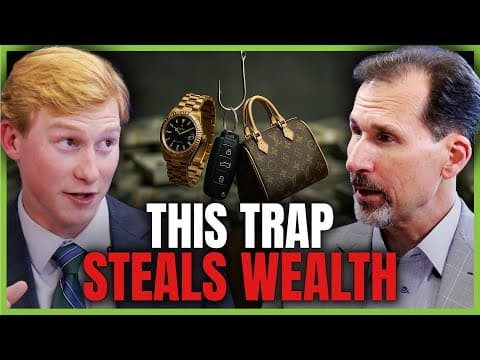
Millionaires Avoid These Everyday Money Traps
Most people don’t go broke from one big mistake, it’s the small, unnoticed money traps that quietly drain their wealth. In this episode, Phil Clark and Spell Carr uncover the everyday spending habits…
Published October 24, 2025
Transcript
You hear it all the time. It's just a coffee. It's just a dinner out. It's just a little extra on the car. But those little choices add up. And for most people, that's exactly where wealth quietly leaks away.
The truth is, millionaires understand that wasteful spending isn't just about dollars. It's about habits, discipline, and whether you're actually moving toward financial freedom or away from it. Today I'm sitting down with Phil Clark who's not only built wealth for his own family, but he's also helped others build wealth for 30 plus years.
You can spot them a mile away. This person will be successful, this person will be a failure. So things like a Starbucks every day, that's a small leak until you do it for a year.
One other thing that'll always allow you to understand if a person's going to be successful or not. They have a pay me first mentality.
Tipping to me is a very controversial subject, but I think it's a conversation that more people should have.
He's going to break down what wasteful spending really looks like, where it hits the hardest, and why millionaires think about it differently. And so my first question for you today is, what is the number one habit you see that quietly erases people's wealth?
It's wasteful spending.
Yes, it is. Phil, that leads me directly into the second question, and that is, what's the sneakiest way people waste money without realizing it?
If all I could do is give you one thought. I think the sneakiest way is people just aren't paying attention. They're not budgeting. And I like to call it leaks. And so when we used to do analysis in companies, the thing that we always look for was profit leaks. Well, in the personal world, in personal finance, it's money leaking all the time and no one's paying attention.
When you hear wasteful spending, to you, what does that mean in real life?
You've heard me say this a lot and I tend to put things in categories and there's really two. There's required expenses. You've got to spend a certain amount of money to live and survive. And there's desired expenses. And I think it's pretty easy to put every expense that anyone will have throughout their life into those two columns, required, desired.
And so those leaks tend to happen when we have desired expenses. And particularly when we confuse them with required, they will create required expenses that are really desired. And they do it not because they're hoping no one will notice. They're doing it to justify it with themselves.
Yeah.
Right. They want to make it okay. And so they will somehow come up with some reason to bump it into that required column when it never belonged there in the first place, but they do it. I think, I'm a transparent person. I think I've been guilty of that. I think we all have. I think we probably... I know I have.
Oh, yeah. I know. I've totally guilty. You know what? That's not a desired expense. That's required. I have to have that.
I talked to someone, Spell. It's been a long time ago, but we were talking about required, desired, and we've used that phraseology for years. And we were talking about their cable and they had the NFL package and I for 10 minutes listened to them justify why that is a required expense. And I finally looked at them and said, "Unless the NFL package or any cable package gives you sustenance, unless you can't live without it."
Yeah.
And there's no justification when you say that you can't live without it. That's just an out and out lie, right? That's completely false. If you can't do that or you don't need it to sustain yourself, it's desired. It doesn't fall into the food, shelter, and health expense category.
No way.
So, you have to get honest with yourself.
Yeah.
Right. We all have to be honest with ourselves. And when we're not, it's easy to either eliminate the columns and just have all your expenses in one column or one bucket, or you get really honest with yourself and you realize if I'm going to become wealthy, if I'm going to be a good steward of my money, and I'm going to have money for a rainy day, and I'm going to get through life without having to worry about where the next meal is coming from or who I'm going to borrow money from to get through.
Yeah, which is another... that's another video in itself.
But you have to get things in order of required versus desired and be okay when you can't get all the desireds. You might get them later. You might have to wait a minute, right? But just don't be okay with always getting it moved over from desired to required. That's really when the leaks start to happen. That's when that wasteful spending starts to happen. It does. It's quiet.
Is there a particular age group you see blowing the most money? And if so, why?
Yeah, it's not a particular age group. Now, I do believe if we were to dig into the stats, Spell, we would find that every group, every age group from the 20s, the 40s, if you will. So 20s up to around 35, 40, and then your 40s to 50s, maybe even 60, and then your retirees. You'll find that all of them have habits of spending.
But I think if I had to point to one group that tends to spend more, it's generally the younger ones in the 20s and 30s because they haven't yet learned the real consequences of what that spending looks like, right? And particularly if they have a family that can support their spending, they sometimes learn really late in the game.
That is true.
Now, the other place that I see it, and I don't get frustrated with it anymore, but I often wonder how can I get these families to listen and to see it a little differently. It's parents and their children and these helicopter families that love to give their kids everything because they believe it's going to make the child either one, want to be around them more, love them more, something. But you can't buy any of the loyalty.
Yeah.
What you can do is cost yourself a lot of money and the child, they're probably going to get over it pretty quick anyway. They're not going to love the toy or the thing that you bought them anyway in a couple of weeks. You're going to want something else. But I think a lot of times people go through that phase of life and they think they've got to give their kid everything, if for no other reason is to keep up with their next door neighbor.
Yep.
So there's just so much frivolous spending, Spell, across every age group.
Yeah.
It's not just one.
When you say helicopter family, what do you mean?
Well, just throwing the money out like it's going out of style. If you just think of a propeller on a helicopter, it's just sending waves of air everywhere. And same way with money, they're just pitching it everywhere. And the hope is that they win curry favor or that they get something out of it. Sometimes I think the parents do it because they're living vicariously through the child. Maybe they are. Who... there's probably all kinds of reasons, but when you talk about where do I see a lot of that wasteful spending, if there's a particular age group, I really think it happens across all of them.
I see people that are 60, 70 year olds, 75 years old that we work with, Spell, and they spend money wildly on their grandkids, for example.
True.
And I get it. I remember the gleam in my father's eye when his first grandchild came along and he happens to be the producer of our show and is Jonathan. And when he came along, I can't tell you what it did to my dad. You would have thought literally that a savior was born.
Wow.
He just... it just took him into a different place. Now, he had other grandchildren, eventually there was plenty. But that first one, I saw something in him that I'd never seen. So, I think a lot of that happens.
Yeah.
People, they just get... they want to take care or spoil his grandkids. And so, that happens. But it's every age group.
Yeah. I agree. Something that affects every age group is the tipping culture, particularly here in the United States. Where did it go wrong? And how do you think people should feel about it?
I'm probably not the best person to ask.
I think you're the perfect person to ask.
Tipping to me is a very controversial subject. I don't ever see... I don't consider this a battle to be won or lost, but I think it's a conversation that more people should have. Spell, you walk into a restaurant today or heck, you could walk into a convenience store and it'll ask if you want to tip the person that... you brought everything to the counter, paid for it, and do you want to leave a tip? And I'm thinking to myself, how much further into the pocket of the consumer will people reach, right?
In my formative years, I remember when tips were really low, if you will, the expectation anyway was around 10% to 15% tops. And there was a certain exchange. By the way, it wasn't just tipping for the sake of tipping, right? Because it happened to be on your ticket. You tipped because there was an exchange for value.
Yep.
You tipped if you had great service.
Yep.
And you didn't then leave the restaurant and apologize about the service by saying, they were probably just having a bad day. I'll still tip them, or I just felt like I had to tip them. It wasn't that, right? If they didn't give you good service, if there was no exchange for value, then you didn't tip.
Yeah.
And you were not stereotyped as a result. You weren't looked at as a bad person because you didn't. Today, people are guilted, Spell, into tipping.
So, how do I feel about tipping? Here's what I think. Whether it's 20% or 25 or 30, which by the way, on receipts now, I know you've seen this. When you get your ticket at the restaurant or your check, it can be 30%.
Oh, yeah.
Right. It's just built in there and they just hope you sign for that. But I think when I go to a restaurant or anywhere that asks me for a tip, I want an experience 100%. And when I'm done with that experience, I want to feel literally compelled to leave them a tip because I'm thinking, I could not get this anywhere else.
That's right.
I just had an experience. It was so good. I want to tip them and I want it to be so good that I want to give them more than they're asking for. When I get that, then I say tips are a wonderful thing because they deserve to be paid if they take it to the next level. If it's truly to the next level.
Now, thing I don't like is I don't like all this business about, hey, tip us so we can give our kitchen staff something. They want to spread and spread and take and take and take, but I think the delivery of service is the ultimate exchange, right? And frankly, if I get a bad meal, I'm not going to blame that on my server.
Yeah.
He or she didn't cook the food.
No, the kitchen. The chef did.
That's right. And for the chef to have the audacity to ask me for more money and they won't even come out and accept that they gave you a bad meal. I got a problem with that.
Yeah. Phil, I used to work at a restaurant, family owned and operated in Topsail Beach.
Yep.
I don't mind saying the name because I love this restaurant. The Breezeway Restaurant on the south end of Topsail Beach.
Been there.
And it's an establishment.
It is an establishment. That's an institution.
It has been around for a long time.
Yeah. A long time.
I started in the dish pit there, then moved to busboy, and then I helped with some of the behind the scenes management type stuff. Our servers made lots of money, but they made lots of money because they provided excellent service day in and day out. We turned our tables over multiple times each night. We served hundreds and hundreds of people a night. Now, we're not talking about a huge restaurant. This is a mom and pop shop. So to do that is impressive.
And I watched as those servers worked their butts off for hours straight. I'm not saying that they were perfect. There were mistakes and bumps along the way. But it bothers me that the consumer is willing to reach into their pockets so deeply to say, for example, tip at the Starbucks drive-thru. I know I'll probably catch heat for saying that, but to be quite honest with you, when I juxtapose the servers who worked and ran and provided a service to people, hundreds of people in a night that sat at their tables and they held conversations, they did all of these things. And then I look at somebody who made my drink that, by the way, might be making 17 or $18 an hour, and they want to get a tip for handing me a drink through the drive-thru. I don't think so.
No, I'm with you, Spell.
And I love the way you frame that because I hope you don't catch heat for it, because the fact is the person at the drive-thru is literally listening to you through a microphone and they might push a button or two. Yeah. But the systems are so sophisticated now that when they speak your order, the system takes the order. They literally do nothing except put it in the cup. That's right. And maybe they put a frother to it. That's it. Yeah. There's nothing there.
Why tip them? Why not let Starbucks, who's making billions and billions of dollars, let them pay their people the right amount. If they're so worried about people not getting paid, and they're always talking about this in the news. Let them pay their people because they're charging you $4 for a cup of coffee. Yeah, don't get me started on that. $3.84 for a venti is ridiculous. I agree. It's crazy. So, no, I'm not tipping them.
I want to say one thing about that waitress or server running. Mh. They earn their tips. There's no doubt. Yeah. With one exception. They can't make it about themselves. That's right. They don't know what the customer is dealing with. The customer might not be the easiest to get along with, but that customer is your paycheck. Yep. They could be spending 50, 60, $80 for a steak, $100 for a steak. Today at some restaurants, you could be spending a lot of money. Yeah. And you have to learn to deal.
So you need to understand that you're in the people pleasing business. You're in the service business. That's right. And if you do a great job with that, then people like us want to tip. Absolutely. What they can't do is come in and have a bad attitude and then get mad when you don't tip them. If you give them a bad attitude, you've ruined their experience. And so I would just say to anyone out there in that business, look, I was in the restaurant world. Yeah, you were. I totally get it. But it's a two-way street. And if they do a great job, believe me, people want to open their wallets.
But I do find it offensive that restaurants, it's not the server asking for the tip. It's the restaurants who don't want to pay anybody. Yeah. And so they want you to do it regardless of the kind of service that you get. If it could go back to the old breezeway style, that couple, the people that own that, they really, I'm sure, drove home the point of what good service looks like to every customer because they understood that customer is what kept the doors open and different today.
It's interesting and then we'll move on to the next question. They understood that the best compliment they could receive was someone coming back. Absolutely. That was what they that they got it. Yeah, they got it. And they instilled that in the people that work for them. And by exchange, a lot of those servers went home with more money than they probably knew what to do with. Yeah. As an investor in a restaurant, I can remember seeing the amounts of money that some of the servers took home. But we always made sure they understood, you're in the service business. Treat these people well. Yeah. And you're going to make a lot of money.
And hey, by the way, today they get some tax-free dollars. That's right. Right. That's right. It's a double bonus right there. If they just treat people good, big tip, and they don't pay tax, that's not too bad. I'm in it right there.
Okay, Phil, can you paint the picture of two people? One who spends their money frivolously and one who's disciplined. What happens to those two people over time?
We'll get right back to today's show. But first, I'd like to ask you a quick favor. If you're enjoying this episode, hit that like button and make sure that you're subscribed to our channel so you don't miss what's coming next. And hey, if something in today's episode has you wondering about your own financial plan, why not get a second opinion? Visit omnirestarfinanicial.com to schedule a consultation with one of our team members. It's quick. [music] It's easy. It could make a huge difference in your financial future. Now, let's get back to the show.
Let's take two people that are similar age, similar income. They have all of basically the same opportunities. So either one of these can turn out really wealthy. Yep. All right. So the one that is being careful with their money, that person is they understand a budget. Mhm. They understand leaks. Y they know what they can afford. They understand required expenses versus desired expenses and they're okay with it.
These people celebrate not by going out and throwing a big party. They celebrate by making another investment. That's right. That's how they celebrate. They don't celebrate by saying, "Oh man, I just hit the jackpot. Let's go take all my friends out and go have a bunch of drinks and eat expensive meals." That's not what they do, right? They say, "I just had another win. What's my next move? What's my next investment?" And they think about it that way. Their first question is always, "What's the ROI? What's my return on the investment?" Yeah. And they don't look at things in any other way.
Now, they'll splurge here and there, but their splurges tend to be on things that create a memory. It could be a nice vacation here and there. It's not going to be lavish, but it's going to be nice. And it could be doing things within their family, giving to someone else. They tend to be givers more than they are takers.
Now, let's juxtapose that with the other person. Okay. So, we got these two profiles. So, there's one that I know they're going to be successful. They live by a certain code, a certain set of rules, and they follow it. They have discipline. Absolutely. It's all about the discipline. They're dialed. Yep.
Now take the other person and here's what happens with them. You take that word leaks and so I talk about required, desired. So now we have those leaks, the profit leaks if you will, they're small, but there's also large leaks. And when they stop knowing the difference, things get really rough. They get in trouble fast.
So things like a Starbucks every day, that's a small leak. Yep. Until you do it for a year and you've all of a sudden added not just the venti but maybe a little bit of food that really sucks at Starbucks by the way, that the food's awful, package junk. But you take that, you got 10 bucks. Yeah. So you do that every day, 50 bucks a week. 50 weeks you've spent a couple thousand dollar, that becomes a pretty big leak.
But here's where the leak gets really bad. Yeah. It's every time they turn around they need a new iPhone. Got to get the latest and greatest. Yeah. And they also need to keep the latest and greatest car. So they want to trade cars every one year, two years, three years. All of those things, Spell, become really, really large leaks. Yeah. And before they know it, they are spending way beyond their means and if not beyond, up to, and so they're not saving anything.
There's one other thing that'll always mark or allow you to understand if a person's going to be successful or not. They have a pay me first mentality. They save into their buckets for retirement or other specific goal oriented buckets. They save there first before spending on anything required or desired. So it's a pay me first mentality, which I think is brilliant. Y.
And the other people, the ones that will fail, that other profile is more of a pay me last. It's I want to have fun. I want to buy all the stuff so that my buddies will see me as someone special and someone that's really on top of it that has plenty of money, and they'll save last. Yep. Which sometimes never happens. Those are the ones that are never going to be successful. And you can spot them a mile away. You can look at their lifestyle. You can look at their habits. And it doesn't take much for you to understand this person will be successful, this person will be a failure.
A lot of us feel, a lot of the viewers in particular feel like the system is designed almost against them. And I'm speaking about social media and the ads on social media and how they're designed by professionals to get you to spend immediately. How do you avoid impulse buys? And how can the viewer that's listening avoid impulse buying?
So impulse buying goes right back to those leaks that I talked about. That is another way of saying you got a leak. So, the impulse buys, and by the way, they're right. If they're thinking that social media is designed or gaming them, they are right. They're absolutely right. Look, Spell, you know this as well as anyone. And I'd love to hear your take on this because I think the system is rigged not in their favor. Yeah. It's designed to say the things that they are going to respond to. These people are experts. They're brilliant. Oh my goodness. Best marketing you'll ever find. And these people know how to do it. And the algorithms put the stuff right in front of the person that is most likely going to act on that ad. Yeah.
And so yes, I think the system is designed for that. But remember, Spell, we live in a country that is more service-based. Y and a country that is all based on consumer spending. They have to get the consumer to spend. That's what happens. So without it, we don't have a growing economy, right? So yes, it's gamed or rigged to really hit their weaknesses. Mhm. And the unfortunate part is once, and the advertisers know this, once that person starts watching their friends do it, they begin to espouse the same behavior. That's right. And they start doing the same thing and before you know it, they're buying all these things.
Now, how do I avoid impulse spending? And how can anyone avoid it? Well, it's not that hard. No. Now, here comes a simple answer that no listener is going to necessarily love. Well, the first thing is turn off the social media. I've done that, right? Just turn it off. You have full control of your phone. Y turn it off. Turn off the computer. Turn off the social media ads. Stop. If it's causing you that much consternation or that much anxiety and you're spending and you're blowing all kinds of money, just turn it off. Yep. Turn off Google. Turn off Amazon. Turn off eBay. Turn off Instagram. Turn off Facebook. Turn off X. Get rid of all of it. Turn it off. Cuz every day you're getting inundated with so many ads and all those ads generally come with something to be purchased. That's right.
Now, one other thing I would say, that one of the other leaks that so many people miss, and in this one, believe it or not, everyone out there's probably guilty of this. It's not knowing what you forgot to turn off that you intended to turn off. Great point. And people don't do it. Great point. For years, Spell, for years, people will allow these subscriptions to sit. They're not using them.
Thank the Lord I have a wonderful wife who's a CPA, and man, she watches it like a halt. Yeah. And occasionally, she'll come in and say to me, "Hey, you know what? You didn't cancel that subscription. Do it." And it's not a will you do it. She throws it in front of me and says, "Cancel." And I do it. And thank goodness she does that because we could be guilty of the same thing, but it happens to a lot of people.
So I just say turn off the social media and don't forget those subscriptions that you're no longer using. Turn them off. And by the way, if you're paying two, 3000, $400 a month for cable or for any kind of TV viewing or you got multiple subscriptions, you need to check yourself on that. Turn that stuff off. How much TV can you watch? That's rhetorical. That's rhetorical. That's 100% rhetorical. How much do you watch? Not a ton. Yeah. Neither do I. And when I do, I want it to be educational. I want something that's going to really help me grow so I can be better at whatever I do. Whether that's making more money or whether that's being good to other people, whatever it is, I want to learn. I don't want to just watch idle television. No. Right. There's nothing good in that. And pay for it. That's no good.
Phil, millionaires waste money, too, but they waste money in different ways. What are three things they choose to spend on and why? And I think maybe you've already alluded to this with one of your answers, but maybe think about some other ways.
Well, I think it's relative when you make a statement like that or ask a question like that because really wealthy people, we say what do they splurge on? Because they will splurge and they do. Yeah. For example, you might go to the local airport and see a very wealthy person with a personal aircraft and people say, "Wow, look at that splurge." But sometimes what looks like a splurge is really by design, right? One, from a tax standpoint, right? But more importantly, it's to move them around quickly because their time is valuable and they understand that. That's right.
Warren Buffett, one of the best examples of that. This guy doesn't care about buying new cars, doesn't want to make frivolous purchases, doesn't care about fancy homes. He does care about nice transportation in the air because his time is valuable. He wants to get there quick so he can do his deal.
I— So sometimes I think what looks like frivolous spending could be by design. But here's what I find with the wealthiest people that we serve: they tend to spend a lot of money on their family.
Yeah.
For what I'll refer to as the family moments. So, it could be global vacations, bringing the family along. They love that. That's really where they get to do a couple of things. One, they can have family meetings. They have memories like nobody's business. It's so good. And they get things that they could never get.
Yeah.
They didn't do that kind of vacation. So, that's certainly one place that I see them do it. I see them do a lot of spending on real estate. They like to have a home and they might want a second home where they can go and enjoy a place that's considered a favorite of theirs. Although, I will say I see less and less of that today.
Yeah.
Because they don't want to have an asset that's just sitting. If there's no ROI, they're probably not going to do it. But the really wealthy people, they will splurge on things with ROI. So whether it's family spending, they will also spend on helping to educate the family. So they're big into spending dollars on things like college education for their grandkids. So that's a big deal to them.
And they love to give. So they're tithers or they tend to be very philanthropic and they make a lot of gifts. I wouldn't say that they spend too frivolously. Now there are those that do, of course, but by and large when they give, they give something that's meaningful to them, that in their opinion matters.
Yeah. It's really how the wealthiest people tend to look at it that way. They're not just blowing money for the sake of blowing it. They don't need tons of collectibles or watches or 40 cars in the garage. Plenty of them do that. But the average millionaire, the way they got there was being careful with their money, being frugal, if you will, not a miser, but being frugal, and they stick to that.
Yeah. And it works. Phil, when is it okay to spend money? When is it okay to buy the $365 coffee or upgrade the car? When is it okay to do those things?
Here's a simple way that I've looked at it for pretty much all of my career, Spell, and I think that most of us around OmniStar talk about it this way.
Yeah.
I think there are three distinct parts to building and keeping and eventually transitioning wealth. One is you have to understand what it is that you're trying to accomplish. So you've got to know what you need to be saving, how much you're going to save, and that your ratio of saving to spending doesn't get out of whack.
All right.
So, one, let's make sure we're filling those buckets. Generally, there's retirement buckets. We want to fill those.
Yeah.
So, the required buckets we need to fill and the savings buckets we need to fill. And then, Spell, when we get past that, investing in other businesses or whatever it might be, whatever the discretionary money is that's left after we've covered all the things that matter as it relates to reaching our goals and our objectives, whatever those are, you then end up with surplus. And whatever that surplus is, I tell people, I know you've heard me say it, I don't care if you burn it, strike a match to it. Strike a match of do whatever you want to do.
I don't recommend that. Actually, don't do that because that's a felony. That's facing money. Don't do that. You can't do that.
Yeah. Don't do that. It's a good point. Yeah. So, strike that. Don't burn the money. But in all seriousness, you do whatever you want with it at that point. I don't care if you buy Starbucks or any other coffee. Whatever you want. As long as you've been prudent with the things that matter.
Yeah.
And you're on track. Which means, by the way, you've got to track it. So, you've got to have some system in place that allows you to track your accomplishments and are you reaching the goals? So, when you've got the surplus dollars, spend it on a Starbucks, spend it on whatever you want. If you want a new car, do that. I don't care.
Yeah.
But I'd prefer you not do it on the larger items that are going to depreciate, right? Avoid those if you can. But if you want to go buy a Starbucks or splurge, go to a nice steakhouse for dinner, whatever you want, do it.
And invite me.
I'll come with you and buy my dinner as well.
I'll come along, too. Phil, these episodes are a lot of fun. And I just want to encourage all of our viewers that if you enjoyed the episode and you found value, we encourage you to share it with others. We encourage you to subscribe to our channel, leave us a comment, and until next time, we'll see you on We're Talking Money.
This transcript was generated automatically and may contain errors in names, figures and terminology. The episode itself is the authoritative version.